Big Walk Review: A Massively Multiplayer Myst-erpiece
House House fulfills the ahead-of-its-time ambition of Uru with a constantly surprising and acutely designed cooperative puzzle odyssey.

At the turn of the century, Cyan Worlds had a fascinating idea: what if the meaningfully lonely and atmospheric puzzle-box worlds of Myst could be solved with your friends in tow? The ambitious experiment that arrived off the back of this train of thought was Uru: Ages Beyond Myst, a short-lived and subscription-modelled ‘Puzzle MMO’ that was later segmented and sold as a single-player experience. Thankfully, the MMO side of the game lives on thanks to a community of players and developers who maintain and nurture Myst Online: Uru Live — a testament to a project whose ambitions were ahead of its time, and the necessary internet infrastructure to catch it and make it a hit.
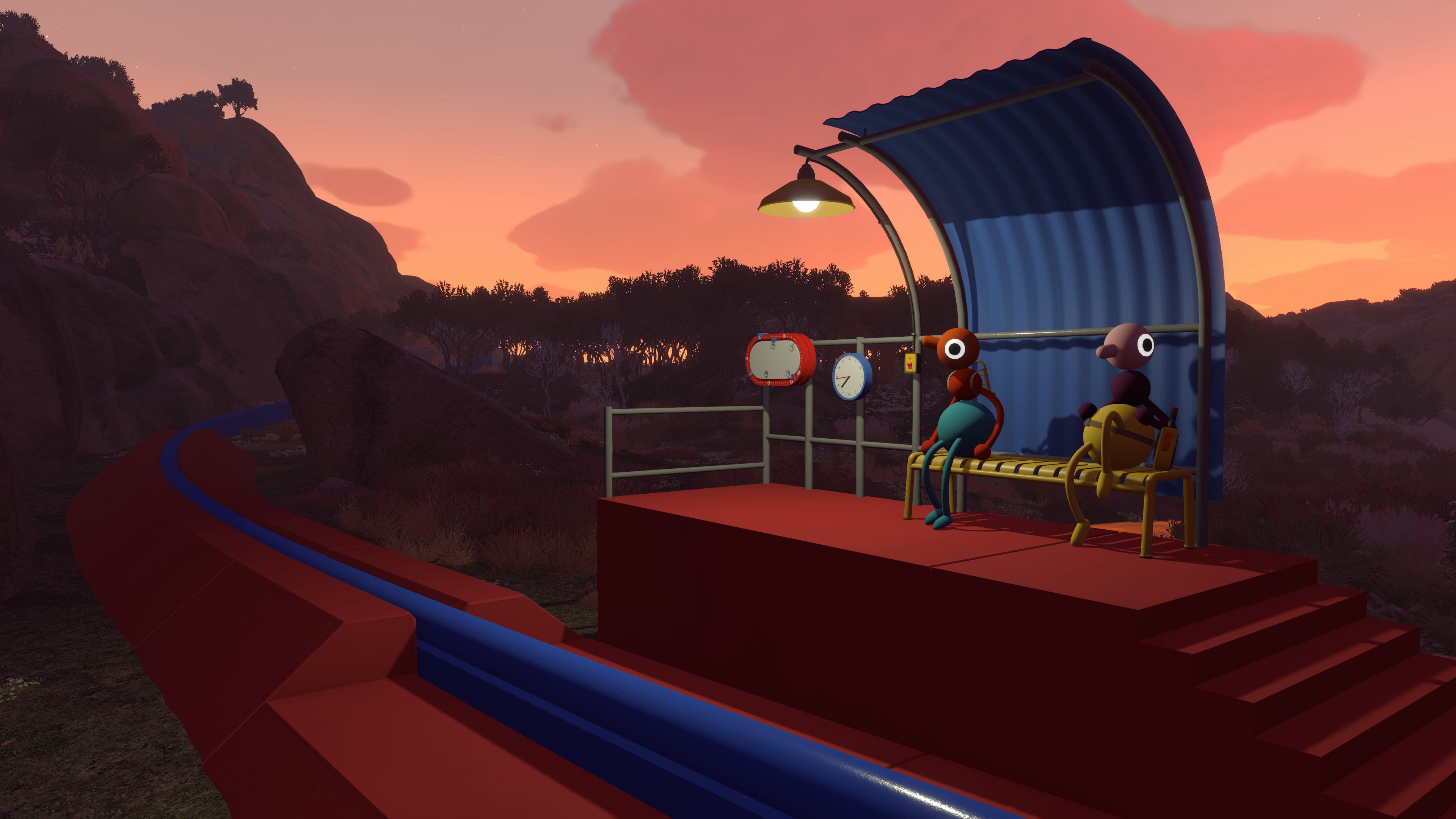
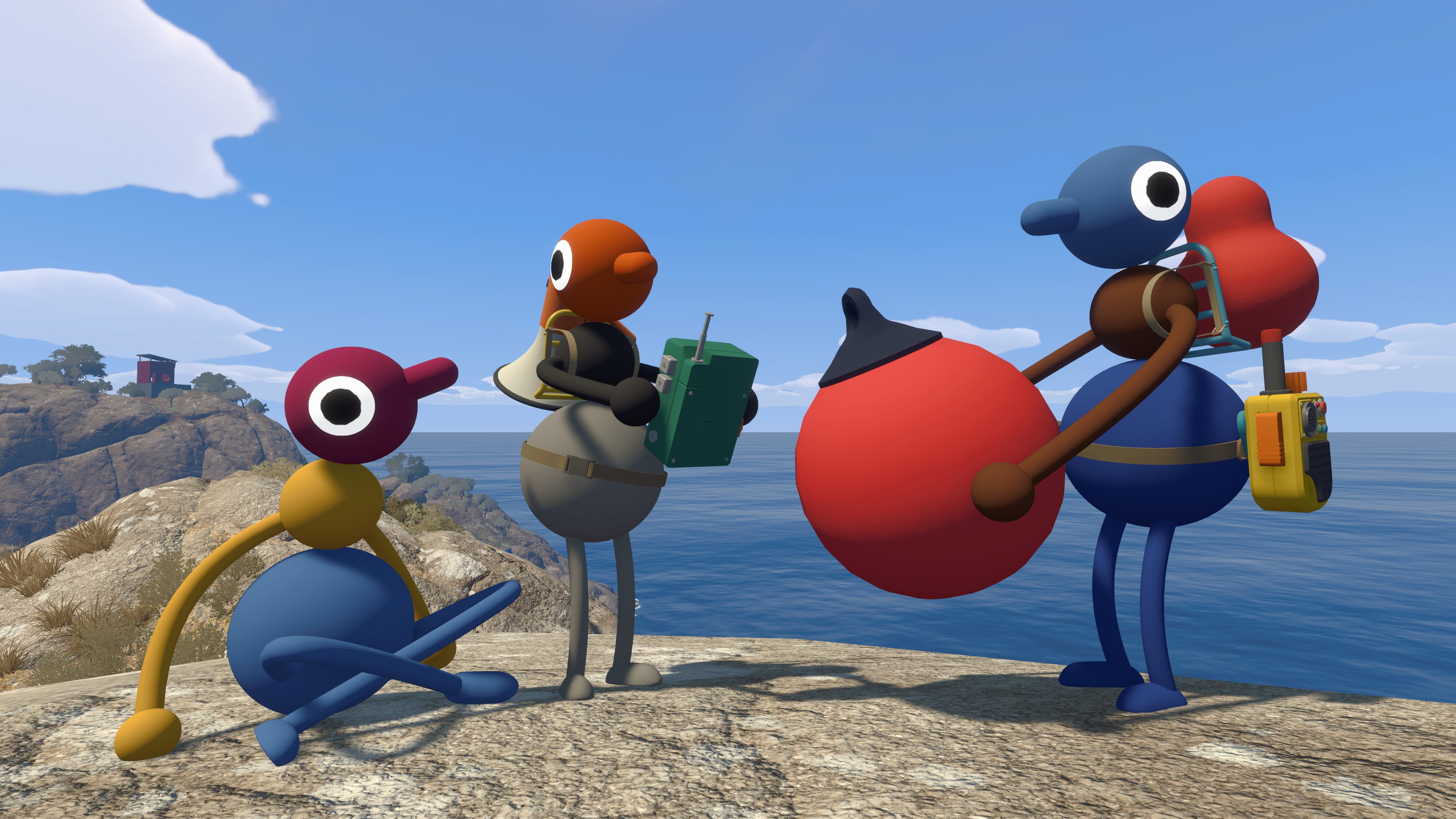
Why am I telling you this? Well, it only took twenty-three years, but the creators of Untitled Goose Game have, consciously or not, produced a spiritual successor at a fortuitous moment in game design, when overcoming obstacles with your friends is all the rage. But Big Walk isn’t like other friendslop games, where stress is baked into every action to the benefit, of, among other things, the algorithm. Big Walk trades in a rich laid-back atmosphere, and transmutes the eerie silence of Hypercard stacks for a sprawling sun-drenched bushwalk with your mates, who all look like anthropomorphised drinking birds.
The playspace is an enormous island of juxtaposition, where Utopian Scholastic monuments clash with the hyperrealism of bottlebrush plants. Receptacles for giant, engraveable keys jut from rock faces, and giant antennaed funnels frame the wild landscape, asserting an unusual artistic tone and serving as a marker for where to head next. It creates a powerful sense of intrigue as soon as you start exploring, with as little as two and as many as twelve players.
The induction zone teaches you to cast shadows, pick and throw objects, stack friends on your head, and perform hand signals. Once you leave it, the world immediately feels like your playground. It’s nice to just amble around and talk in this beautiful third space, but you will inevitably run into the aforementioned monuments, where a little puzzle may be afoot. It gets so much more complicated than this, but you might be tasked with relaying information while a sense is being deprived, or asked to achieve a deceptively simple task, like launching a ball into a hoop, or transporting items from one area to another. As you might expect, much of the wonder of Big Walk lies in discovering its systems for yourself and in the intentional way they reveal themselves.
You might not understand a puzzle, but that’s fine; you can, especially to begin with, just move on and look elsewhere — this is all part of today’s Big Walk, and you’ll probably be back tomorrow. But it’s not totally freeform, of course. Despite the game’s distinctly open-plan design, there is some linearity in its structure. Gates are opened with the collective spoils of your puzzle labour, leading you into even broader sections of wilderness that hum with secrets and headscratchers.
Along the way, you’ll encounter simple tools that, in contrast to what you bring with you, resonate like paradigm shifts for your capabilities as a puzzle-solver archaeologist. A day-night cycle also radiates welcome entropy into the mix, compounding the difficulty of a puzzle or trivialising it. The restraint shown in allowing the game to do this sort of thing to its players and create unique experiences is what makes Big Walk so dazzling in its totality. There’s no doubt that a simple puzzle to another group makes total sense to yours, and vice versa. The difficulty settings also suggest an ability to alter the tenor of puzzles depending on the number of players, too, ensuring no two runs are the same. I was reminded of how many times I’d played Portal 2’s co-op campaign and found myself stuck because of the differing communication styles across my partners in puzzle crime.
Eventually, through the introduction of notes and relay stations, you begin to construct a community centre at the heart of this game’s world, which takes the edge off the need to briskly clamber towards Big Walk’s conclusion. And that’s important, because it’s a game that blooms when played without any auspices or pressure, when the most interesting thing is what could be hiding in a suspicious-looking tube or treacherous ravine. The clumsy ease in which you can lose what you’re holding enables a deeper sense of discovery. It’s frustrating to launch a key item into a void of darkness, of course, but you’d be a fool not to enjoy the odyssean consequences and memorable blabbering that follows.
And speaking of blabbering, Big Walk’s complicated proximity chat system adds a healthy amount of entropy to the scenario, too. Modulation is context-sensitive, and amplified by the scope of certain puzzles. You will, at times, want to boot your friends off the side of the mountain because of it. The best part is that you can, and it probably won’t be the end of the world.
I expect Big Walk to summon many narratives about the need for us all to reconnect with nature, and the power of video games to replace the dormant real-world spaces where people once would earnestly chat. If you’re of a certain age where you have some context of life before the internet like I have, you may feel these urges come through quite strongly as you pitter-patter across the island, yapping directions at your lost friends.
Without a deadly, encroaching fog or anyone to kill, Big Walk quite naturally summons a string of anecdotes and, with its penchant for downtime, lets you sink deeper into your subconscious and meaningfully reminisce. Stress is baked into the concept of friendslop, to the point where all the memories you tend to make in those games look forward. But here, the great silence, time to ponder and room to breathe led me to look backwards, too. I thought a lot about the rose-tinted times when I was lost in the real world for the sake of it as a youngster, and whether I should temper that kind of activity again. In this sense, the game’s initial absence and slow introduction of technology feels intentional.
As you’re embarking on the long journeys between its key areas, maybe you’ll think about the first time you kissed someone, when you badly grazed your knee, or when you sneaked your first underage drink. Beyond its mechanical genius and abundance of clever puzzles, Big Walk is special in the way it instils a powerful yearning for the past and for an outside world that doesn’t exist. One that looks just like this, where we can paint eachother in any colour and leave warm trails of light for everyone to follow.
Outside of games like Myst and Riven, it’s rare to find games that transport you to another world adjacent to our own, set you free to unearth a culture, and then let you return to your own with an expanded mind. However, it’s even more rare to find a game that lets you share that experience, and one that makes you feel like you’re contributing to the culture of the space as you explore it. Maybe Big Walk’s legacy will be more than just a feeling of accomplishment from toppling its hardest challenges, but about what players build inside of it, and how they respond to what they unearth in its most interesting corners.
The Verdict
Few games are as immediately and intuitively fun as Big Walk. By stripping away the stress and driving at the bedrock of our urge to play, House House has summoned an interactive experience that feels uniquely refreshing, mechanically playful and socially intimate. Gather your friends and avoid any context you can, as, like Death Stranding 2, this is another Australian odyssey that you won’t forget in a hurry.