

Q-Games on Yodelee Golf, The Best Game I Played At Bitsummit 2026
A whistlestop tour of Japan's premier indie game event, and a chat with one of the Kyoto scene's most prolific studios

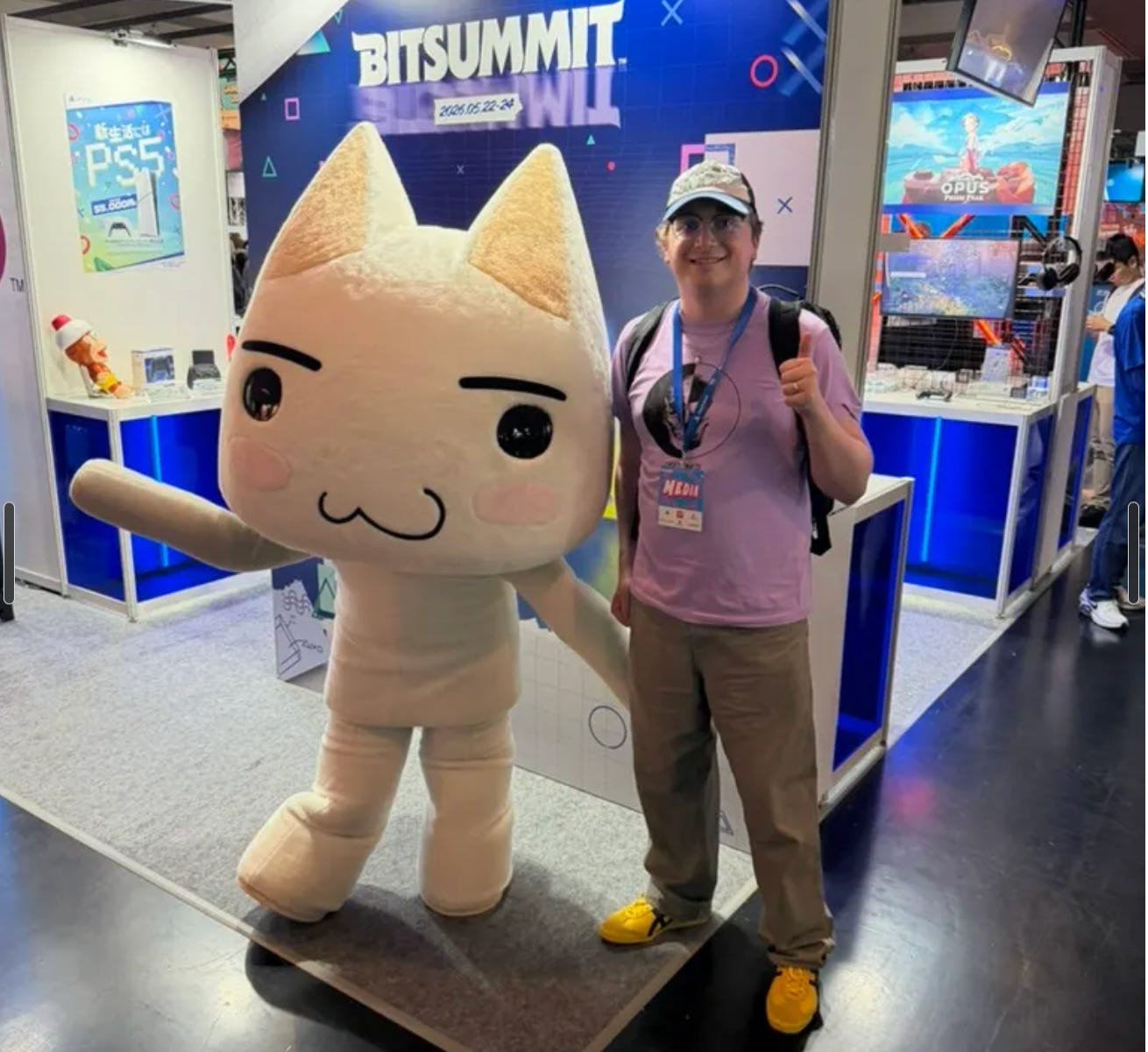
Earlier this year, at the end of May, I was lucky enough to attend BitSummit Punch in Kyoto. I’ve been to E3, gamescom, and even the Queensland Games Festival, but this marked my first video game event in Japan, and I was there for only one day, so I had to be efficient. However, as soon as I walked in, there was a photo opportunity with a celebrity—Toro Inoue of Doko Demo Issyo fame —which I quickly pounced on. Journalism!
Speedrunning the Show Floor
After that, though, it was time to check out some games. First up, I played Denshattack! at the Nintendo booth, a wonderful ‘Jet Set Radio meets Thumper’ arcade game where you play as a commuter train with the soul of a skateboard. I then gravitated toward the Critical Reflex booth for some gristlier indies and was met by Inkblood, an appropriately dark inquisitor simulator — and maybe even a brilliant Golden Idol-like adventure, per the build I played. I also had a spin on the gorgeously surreal Burden Street Station, which felt pulled from an alternate timeline where GrimE adventure games did Call of Duty numbers in the late 90s.
I then wandered past an installation where you could play cemetery sim Graveyard Keeper 2 inside a coffin to have a go at a real-life version of No, I’m Not A Human. Very robust adaptation where you peer through a keyhole and look for incriminating body parts, and decide to let the person in… or slime them. I failed after three or four door-blokes, but it was fun.
Deadly Flora and Beetle Pensioners
Elsewhere, I was literally stopped in my tracks by a game called The Florist, a fixed-camera, magical-realist survival-horror game where you tango with deadly flora. Over someone's shoulder, I watched a punter play the demo. A graceful throwback, to be sure, but it’s the art style that wowed me — it’s rare to find convincing realism-skewed art direction in the indie space, so much so that I figured this game had to be from a first-party studio. Alas, no, the art team at Unclear Games just has a spellbinding command over light and shadow. Hats off.
Tying things off, I had a short conversation with a trio of developers on my way to the afterparty, in which I learned about two more fascinating games: Beetols They Do It, in which you collect beetles with old men's faces to populate a retirement village (and sell the eventual cadavers to ethical collectors), and Clownbaby, a clown-fronted dating digestion x deckcrumbling game by T-Dog. The exchange firmed up my existing belief that Screen Australia (and the down under indie scene in general) is on a generational run right now.
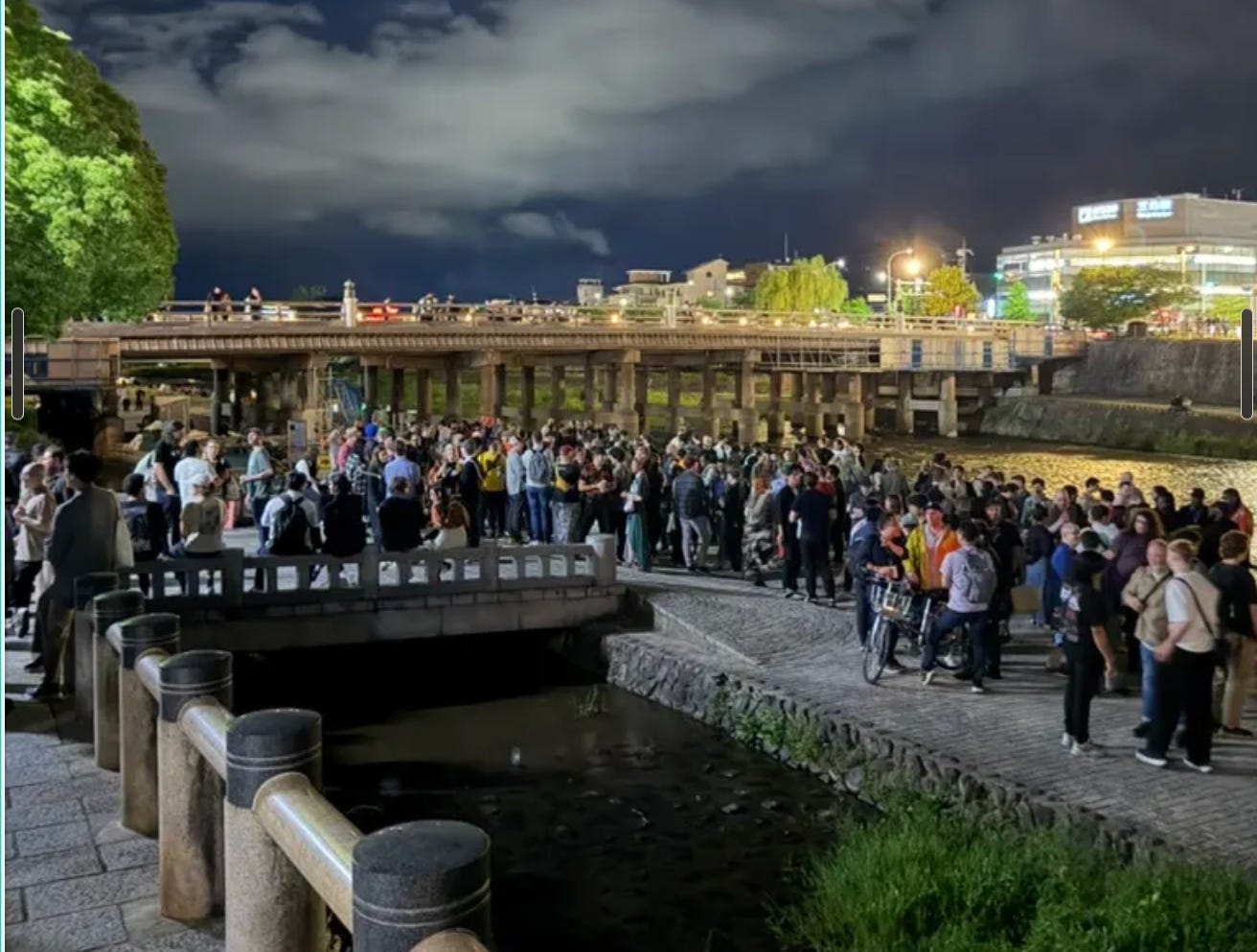
But what was the best game I played at BitSummit? The game I was still thinking about as I sipped sake from little branded wooden cups and respectfully supped a cappuccino on the banks of the Kamogawa River? Well, my friends, it was Yodelee Golf by Q-Games.
Fore!
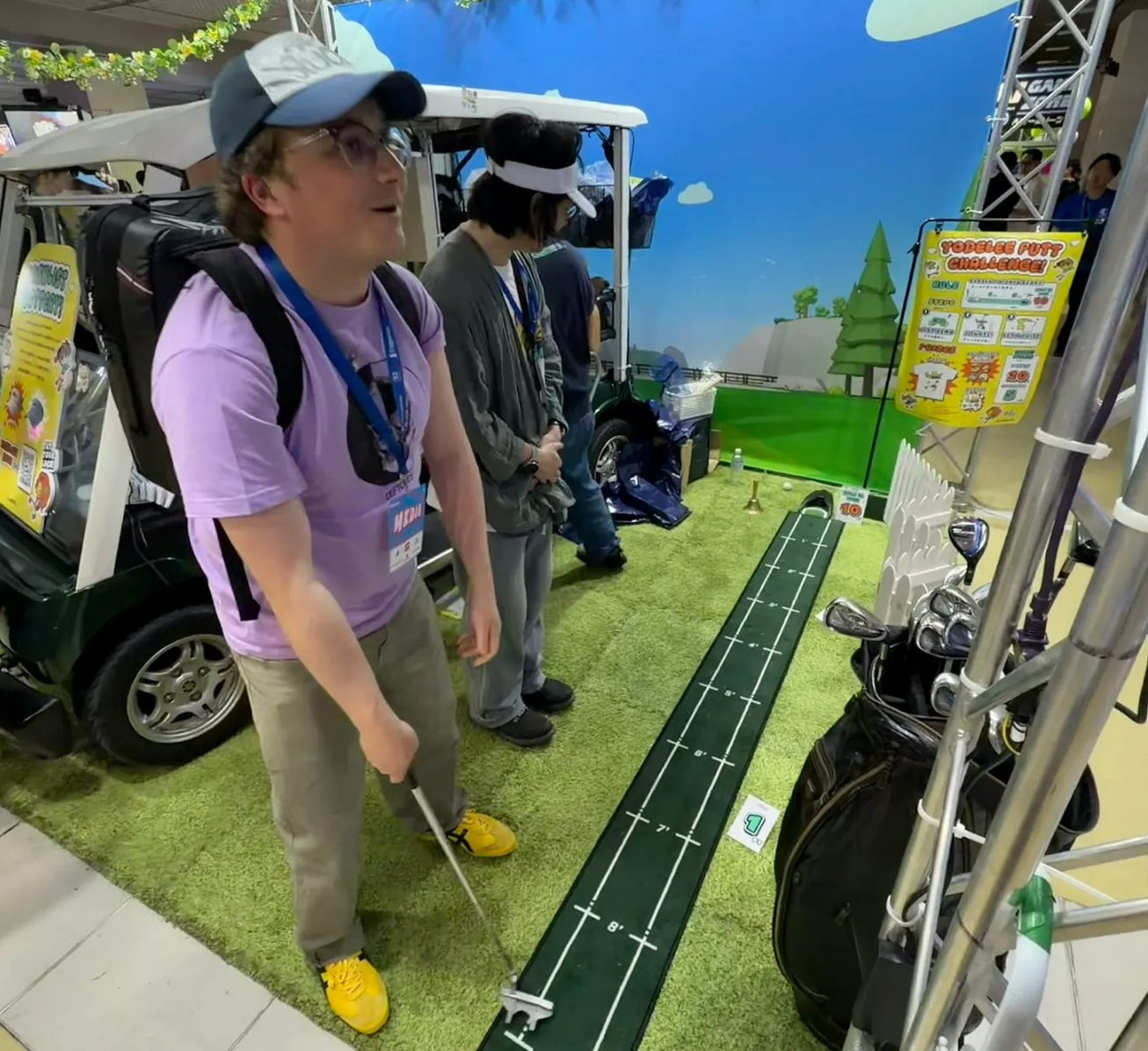
As you can see from the picture above, Yodelee Golf had the best booth at BitSummit Punch, with a full-blown golf cart (where you sit and play the game with three other people) and a putt-putt challenge where you can win some goodies afterward. But not content with winning over my sentimental heart, it convinced my game-playing fingers too. Yodelee Golf is a lawless open-world golfing adventure where everyone can hit the lone ball. So you and your friends strive to reach the hole while avoiding distractions like mobs of angry deer, the allure of gravity-defying golf carts and bicycles, and the urge to chase big hunks of meat that can replace your 9-iron.
I laughed my sock-puppet head off as we lumped the ball into god-knows-where every 10 seconds, enacting Snowrunner-like rescue missions for the projectile, and stumbling into hidden caves and myriad daft surprises that cajoled our group into chatting. Summoning communication between players is life-or-death for games of this nature, and Yodelee Golf had that locked down from the moment I went hands-on. There was no question we needed to yap to reach the end, but there wasn’t a super serious air about the objective, so you could just yap and giggle your way forward without losing momentum. I didn’t want to stop playing, despite my tight schedule.
That’s all without mentioning the cool USP: Yodelee Golf has ray-traced proximity chat, which I haven’t seen in any other game. Basically, it paints what you’re saying above your head as you’re saying it, creating a cacophony of live captions on the screen and then on the green. It’s absolutely hilarious to look at, wonderfully useful for communication, and it helped cement Yodelee Golf as one of the games I’m most looking forward to playing with my friends — potentially the next third space of record alongside golden oldies like Ultimate Chicken Horse and Golf With Your Friends.
Of course, Yodelee Golf was mechanically convincing (there’s a lovely thwack to each swing, and the ragdoll mayhem is finely tuned), but there’s also just so much room for this kind of game right now, when our brains are fried, but we want to be engaged in a light, playful way while enjoying each other’s company. Cozy friendslop, if we have to give this genre a terrible name, but I think it’s on the rise, especially with Big Walk lurking over the horizon.
Q&A: Suzuka Kobayashi, Creative Director on Yodelee Golf
With all this in mind, I sent Q-Games some questions to clear up some post-playtime questions and propel my excitement past the vertical slice. Here’s what Creative Director Suzuka Kobayashi had to say:
The Q-Games back catalogue is wonderfully eclectic, but Yodelee Golf still feels like a departure from your previous work — where did the idea for this one come from?
SK: I think Q-Games has always been a studio that values slightly unusual cooperative experiences and play that emerges from relationships between players. A good example of this is the three-player co-operation in the original PixelJunk Eden or the asynchronous “strand”-like co-operative gameplay in The Tomorrow Children.
The initial idea for Yodelee Golf didn’t come from a simple idea like “let’s make a golf game” but from wanting to replicate the fun of proximity chat in big-budget titles like Arc Raiders in a friendlier, cozier game.
By combining proximity voice chat with live transcription of your voice to manifest 3D words in the world around you, it was thought that conversation itself could become part of the gameplay. Therefore, this work is not so much a recreation of golf as a sport, but rather a “cooperative adventure shaped like golf.”
Why do you think Golf is such a popular vector for video games? Yodelee Golf is yet another exciting new idea from the indie space that uses golf as a basis for its concept (What The Golf? Golf Story, Cursed to Golf, etc)
SK: I think golf is a very suitable subject for video games. The rule of “hitting a ball and getting closer to the target” is extremely simple, so players can understand it right away. On the other hand, terrain, angles, power control, obstacles, and randomness allow gameplay to expand in countless ways. In other words. I think golf is like a “vessel” with rules that anyone can understand, yet one that still gives us enough room to have fun.
In Yodelee Golf, we want to make full use of that framework. While preserving the fun of hitting a ball with a club, players can talk with companions along the way, wander into strange places, and encounter unexpected happenings. We want the entire “process of getting to the destination” itself to be the game.
Can you explain how the ray-traced proximity chat works on the technical side? Can players overload the game with too much chatter?
SK: Ray-casting audio is much easier than ray-casting 3D graphics, so there isn’t much load on the game as a result. Each audio source emits in a number of directions each frame, and the audio is played back for each surface the ray hits.
I am deaf in my right ear and suffer from hearing loss, so I found the 3D Text especially useful during my play session! Have you considered it as an accessibility feature, too?
SK: Regarding the hearing in your right ear and the fact that 3D text was helpful, we will definitely use this as a reference for development! Originally, it started as a playful idea: that instead of just hearing voices, it might be interesting to leave the speech behind as something “visible” or even physical within the game space.
However, while observing players’ reactions at events like BitSummit, I strongly felt that this feature also has great potential for accessibility. Even in situations where it is difficult to hear voices, displaying the speech as text in the space makes it easier to understand who said what and where the voice came from.
At this stage, we cannot say that the accessibility features are fully complete, but it is an area we want to place great importance on going forward. We aim to make it not only fun as a game, but also a system that allows more people to play together.
Can the system handle all languages and accents? How have you tested this so far? I’m from the North-East of England (Geordie accent), which is considered quite strong, and I noticed it was handling my voice pretty well!
It is difficult to say whether all languages and accents are fully supported. However, we aim to make it something that feels natural for as many players as possible.
In previous tests, we have mainly worked with Japanese and English and have interacted with players who speak in various accents within the development team and at events. At BitSummit as well, many people played the game, allowing us to check the performance of voice recognition and 3D text responses. We were also very encouraged to hear that it could accurately recognize even the Geordie accent!
Recognition accuracy may vary depending on accents, speaking speed, and surrounding noise. Therefore, we will continue testing and make adjustments so that it remains fun as a game while also being as practical as possible.
How can “shouting at the ball influence its direction?” Is there a sort of ‘limit break’ where enough decibels can push a ball into a hole or lead a drive to go longer than anticipated?
Currently, voice is mainly used for communication between players and for playful uses where it remains in space as 3D text. However, the idea of “interacting with the ball and the world through voice” is very appealing, and we are exploring various possibilities. For example, gameplay in which something reacts to the volume or direction of your voice, or in which using your voice in specific places triggers gimmicks, could become elements unique to Yodelee Golf.
On the other hand, if we make a system where the more you shout, the more advantageous it becomes, there is a possibility that the way people play will become somewhat biased. Therefore, even when incorporating voice-based elements, we want it to be about more than shouting loudly being the correct answer; it should be connected to communication with teammates and the situation at hand.
Can you talk about some of the ‘strange surprises’ players can expect to find scattered through the world?
In Yodelee Golf, we want players to not just aim to win, but also to encounter unexpected events along the way that make them think, “What is this?” For example, terrain that wouldn’t normally appear on a standard golf course, places that make you want to take a detour, and mechanisms where incidents naturally arise from conversations between players.
Even in the BitSummit demo, there were moments when players, while chasing the ball, ended up going to unexpected places and bumping into each other, getting more excited about things other than the ball itself. We want to cherish those kinds of events: things that aren’t necessary for clearing the game but that you’ll want to talk about afterward.
Is there a way to overlay the in-game chat feature when in a Discord lobby or using a group chat on PlayStation, or something similar?
Once we move to a production release, we will look into this feature as it would be really useful, I think!
Often, games of this nature thrive when they force players to communicate with eachother, though Yodelee Golf is, unlike Peak, still quite cosy. How does the game push players to chat to eachother in a typical match?
In Yodelee Golf, we focus on creating situations that naturally encourage players to want to talk, rather than forcing them into conversation. For example, telling your teammates where the ball went; discussing which route to take next; laughing when someone makes a mistake; calling out to teammates who are far away; finding something strange and shouting, “Come here!”
I believe that the accumulation of these small conversations is what leads to the fun of the game. This game is not so much about putting players under pressure with tension, but rather about creating an experience where you can wander around a wide area and have fun getting lost together with friends. However, it’s not entirely peaceful - slightly strange things and unexpected happenings can occur. I think that balance of being “cozy but a little weird” is what makes Yodelee Golf what it is.
What lessons from your previous experimental multiplayer games (The Tomorrow Children, All You Need Is Help) have you brought to Yodelee Golf?
One thing we learned from Q-Games’ past titles is that in multiplayer games, the relationships between the players themselves become a major part of the content. In All You Need is Help, it was important for players to cooperate while observing each other’s shapes and movements. In Yodelee Golf, rather than assigning perfectly defined roles, the aim is to create an experience where players look at the same situation, communicate with each other, and even enjoy accidental mistakes.
In cooperative games, it is also important that the objective is easy to understand. With a simple goal like “get the ball into the cup or destination,” players can immediately understand what they need to do. On top of that, by adding free detours and unexpected events along the way, we want to create different memories every time.
The sock puppet character designs create an immediately attractive and highly unique sense of art direction. Where are you taking visual cues from for Yodelee Golf?
Based on the premise that it’s good to have a character that makes talking fun, during a team brainstorming session, one of the members showed us a certain cartoon animation. It was a 2D work, and every time the character spoke, its mouth would flap open and closed. We got really excited, thinking it would be interesting to use this in 3D space as an avatar of ourselves. Within that same week, we even created the motion, a prototype character model was born, and that is what has been carried on to this day.
Are there any progression systems in this game, or things that carry over between matches to keep players coming back for more? How will the maps change between sessions?
We are still in the process of considering and verifying the progression elements. In Yodelee Golf, we want to emphasize replayability that encourages players to discover new places, find new ways to play, and try different routes from their friends.
We are also adjusting what carries over between matches and how much the map changes, in line with the game's overall structure. However, rather than having the exact same play experience every time, we want to create a game where different memories remain depending on who you play with, where you take detours, and what kinds of unexpected events occur.
You chose to debut the game at Bitsummit — how does the atmosphere and special energy of the Kyoto indie scene fuel your development? And how has the response been so far, in person and online? Any funny stories from the public play sessions?
I think BitSummit, as an indie game event held in Kyoto, is a place where developers and players are very close to each other. For a game like Yodelee Golf, where the reactions when people actually gather and play are very important, BitSummit was a very good place.
On site, there were moments where players naturally spoke to each other, got excited about things other than chasing the ball, or unexpected accidents with the clubs created laughter. Including online reactions, it was very encouraging that people showed interest in the system where voices become 3D text and in the parts that turn it into a slightly unusual cooperative adventure, despite being golf.
The feedback we received at BitSummit has become extremely important for our future development. In particular, we felt there was potential not just in playing golf, but in taking detours with friends and enjoying unexpected events along the way.